

In the world of robotics, industrial automation, and consumer electronics, the DC motor is a fundamental component that converts electrical energy into mechanical motion. However, not all DC motors are created equal. The choice between a brushed and a brushless DC motor can define the efficiency, lifespan, and control precision of an entire system. For engineers, researchers, and R&D teams, understanding the technical trade-offs between these two technologies is not just a matter of preference—it is a critical design decision. In this comprehensive guide, we will explore the internal mechanics, performance characteristics, and control strategies that distinguish brushed and brushless DC motors.
To appreciate the differences between these motors, we must first understand their internal architectures. While both rely on the principles of electromagnetism, they achieve commutation—the process of switching the current to maintain continuous rotation, in fundamentally different ways.
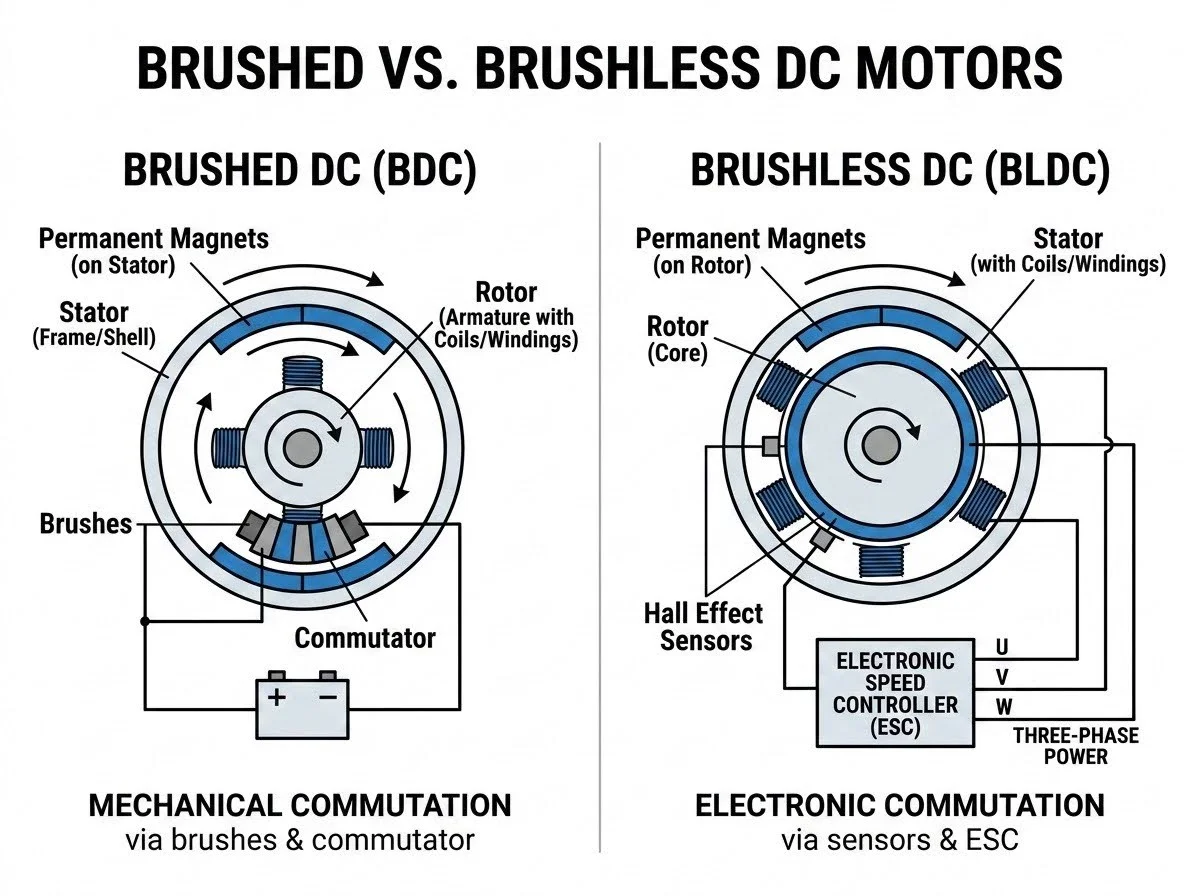
The brushed DC motor is one of the oldest and simplest motor designs. Its operation is purely mechanical. Inside the motor, a set of stationary carbon brushes makes physical contact with a rotating commutator. As the armature (the rotating part) turns, the brushes slide over the segments of the commutator, reversing the direction of the current in the windings at precisely the right moment to keep the motor spinning.
This design is “self-commutating,” meaning it can run directly from a DC power source without any external electronics. This simplicity has made brushed motors the standard for over a century in applications where cost and ease of use are paramount.
As the name suggests, brushless DC motors eliminate the need for physical brushes and commutators. Instead, they use electronic commutation. In a BLDC motor, the permanent magnets are mounted on the rotor, and the copper windings are part of the stationary stator.
Because there is no mechanical contact to switch the current, an external electronic controller—often called an Electronic Speed Controller (ESC)—is required. The controller uses sensors (such as Hall effect sensors) or measures back-electromotive force (Back-EMF) to determine the rotor’s position and then switches the current in the stator windings accordingly. By moving the windings to the stator, the motor can dissipate heat more effectively, as the heat-generating components are in direct contact with the motor’s outer shell.
When evaluating motors for high-performance applications, several key metrics come to the forefront. The following table provides a high-level technical comparison of the two technologies.
One of the most significant advantages of BLDC motors is their superior efficiency. In a brushed motor, the friction between the brushes and the commutator generates significant heat and energy loss. Furthermore, because the windings are on the rotating armature, heat is trapped inside the motor, making cooling a challenge.
BLDC motors, by contrast, eliminate friction losses and place the windings on the stationary stator. This allows for much more efficient heat dissipation through the motor housing, enabling higher power outputs in smaller packages. For battery-powered applications like drones or portable medical devices, this 10-15% efficiency gain translates directly into longer runtimes.
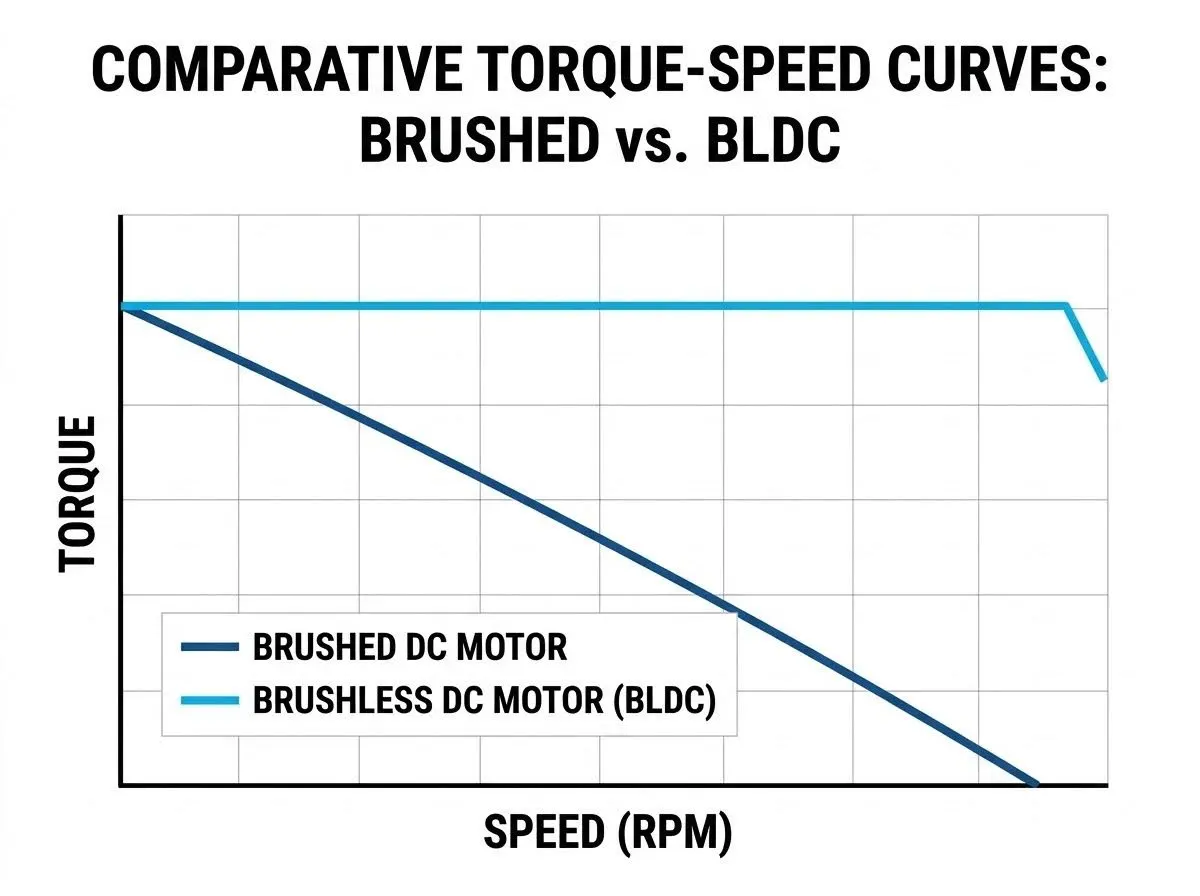
In control systems engineering, the speed-torque curve is a vital tool for motor selection. Brushed motors typically have a linear relationship between torque and speed, which makes them easy to model and control. However, they struggle at high speeds due to the mechanical limitations of the commutator and the increasing friction of the brushes.
BLDC motors exhibit a “flatter” speed-torque curve, meaning they can maintain high torque across a wider range of speeds. Their lack of mechanical commutation allows them to reach RPMs that would cause a brushed motor to fail due to centrifugal forces or excessive sparking.
While brushed motors can be controlled with a simple PWM (Pulse Width Modulation) signal to adjust voltage, BLDC motors require sophisticated algorithms to achieve optimal performance. The choice of commutation method significantly impacts the motor’s behavior.
This is the most common and simplest form of BLDC control. The controller energizes two of the three phases at any given time, creating a magnetic field that “pulls” the rotor in six distinct steps per electrical revolution. - Pros: High maximum speed, low computational requirement. - Cons: High torque ripple (pulsations), audible noise, and lower efficiency at low speeds.
To solve the torque ripple issues of trapezoidal control, sinusoidal commutation provides a smooth, continuously varying current to all three phases. This creates a rotating magnetic field that is much more uniform. - Pros: Smoother rotation, significantly reduced noise. - Cons: More complex mathematics, requires higher-resolution position feedback.
FOC, also known as vector control, is the “gold standard” for BLDC and PMSM (Permanent Magnet Synchronous Motor) control. It uses complex mathematical transformations (Clarke and Park transforms) to decouple the current into two components: one that generates torque and one that generates magnetic flux.
Pros: Highest efficiency, zero torque ripple, excellent performance at very low speeds.
Cons: Requires high-performance microcontrollers and precise current sensing.
Mathematical Note: The Ideal Motor Model Both motor types can be described by the fundamental voltage equation:
For industrial R&D teams, the “total cost of ownership” is often more important than the initial purchase price.
The primary failure point of a brushed motor is the brush-commutator interface. As the brushes wear down, they create carbon dust that can contaminate the motor’s internals or even cause short circuits. Furthermore, the constant sparking at the commutator generates significant Electromagnetic Interference (EMI), which can disrupt sensitive sensors or communication lines in a robot. In environments with explosive gases, the sparks from a brushed motor pose a severe safety risk.
BLDC motors are essentially maintenance-free. Their lifespan is typically limited only by the quality of the ball bearings. They are ideal for “set and forget” applications or for use in cleanrooms and medical environments where carbon dust cannot be tolerated. However, the reliability of a BLDC system is heavily dependent on the Electronic Speed Controller (ESC). If the ESC fails, the motor becomes useless.
The decision between brushed and brushless depends on the specific requirements of your project.
The evolution from brushed to brushless technology represents a significant leap in motion control. While the brushed DC motor remains a reliable and cost-effective solution for many basic tasks, the brushless DC motor has become the standard for modern high-performance engineering. By eliminating mechanical friction and leveraging advanced electronic control strategies like FOC, BLDC motors offer a level of efficiency, longevity, and precision that was previously unattainable.
